
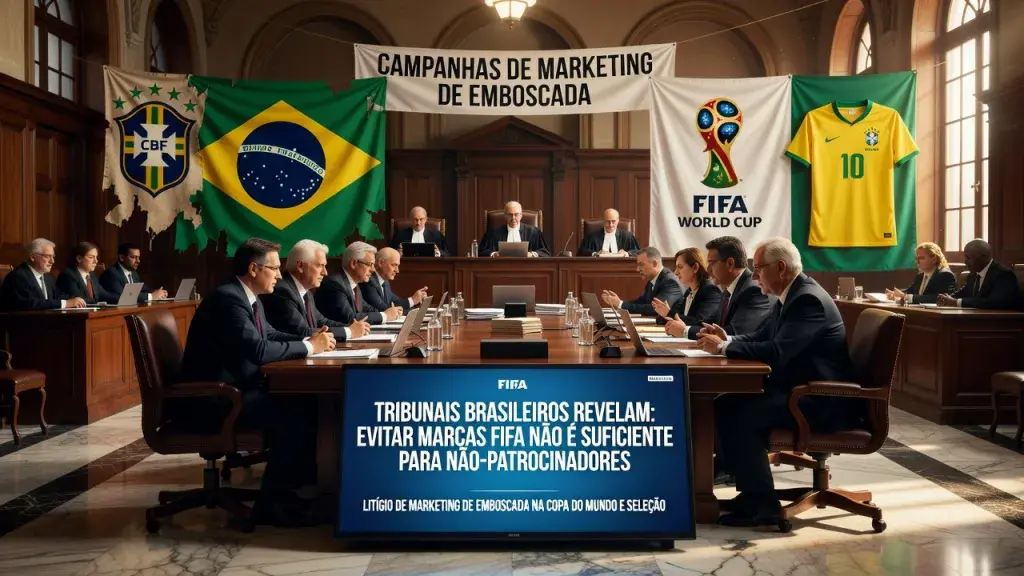
Brazilian Courts Reveal Why Avoiding FIFA Marks Is Not Enough for Non-Sponsors
Authored by cn-ayxsports.net, 18 Jun 2026
For brands planning campaigns around major football tournaments, the first legal checkpoint is usually straightforward: has the campaign used any protected FIFA marks? It is a necessary question, but a series of Brazilian disputes - spanning federal courts, civil litigation and the country's advertising self-regulatory body CONAR - demonstrate that it is far from sufficient. A campaign can be entirely free of official logos and still be found to have unlawfully occupied the commercial space that an official sponsor paid to occupy.
The stakes are sharpening heading into the FIFA World Cup 2026 cycle and beyond. FIFA's 2026 IP Guidelines set out the tournament's protected marks and assets, while Brazil's General Sports Law creates specific offences for ambush marketing by association and by intrusion. Yet the practical exposure for non-sponsors is broader than either document captures. The same campaign execution can simultaneously attract unfair-competition claims, civil liability, image-rights challenges and advertising self-regulation complaints - none of which require proof that an official badge was used. What they require is evidence that the public was led to perceive approval, endorsement or official sponsorship that does not exist. It is worth noting that this kind of associative strategy is a world away from transparent commercial arrangements in other entertainment sectors, such as combat sports platforms that openly advertise where to bet bkfc - a directness that sports marketing law in Brazil is specifically designed to prevent brands from mimicking through implication rather than disclosure. where to bet bkfc
Brazil's relevance here extends beyond being a large consumer market for global campaigns. The country will host the 2027 FIFA Women's World Cup, making it simultaneously a live market for the current sponsorship cycle and the central reference point for the next major round of FIFA commercial agreements. Brands, agencies and their legal teams operating in or targeting Brazilian audiences have every reason to treat the country's body of ambush-marketing case law as essential reading.
When Your Own Branding Becomes the Problem
The 2010 "Seleção dos Poupançudos" campaign, run by a Brazilian federal savings bank, is perhaps the most instructive starting point. The advertiser used its own fictional characters dressed as football players. The shirts reproduced the general layout and colour palette associated with the Brazilian national team, and the advertiser's own mark appeared precisely where the CBF badge would ordinarily sit. Brazilian federal courts found this constituted ambush marketing. The critical analytical point is that the prominent placement of the brand's own mark did not insulate it from liability - on the contrary, it was the mechanism by which the brand slotted itself into the symbolic position occupied by an official sponsor. Swapping the federation crest for your own logo is not a defence; it is a description of the offence.
Coca-Cola encountered similar reasoning in litigation arising from the same World Cup cycle. Former Brazilian internationals appeared in Coca-Cola advertising wearing yellow shirts that closely resembled the national-team uniform, without the CBF badge. The company was found liable for associating its product with the reputation and success of the national team. That logic resurfaced in 2018, when the CBF and Ambev challenged a campaign featuring Neymar dressed in clothing that evoked the Brazilian uniform. A favourable decision followed. In both cases, the determinative question was not who owned the colour yellow - no one does in any absolute sense - but whether the overall combination of athlete, styling, timing and narrative created an impression of institutional association.
Athlete Agreements Do Not Cover Everything
A common assumption in campaign planning is that securing a valid athlete release resolves the association risk. The 2014 TAM Airlines case illustrates precisely why that assumption is dangerous. TAM featured Brazilian internationals Thiago Silva, David Luiz and Marcelo in a campaign structured around the message that the airline would "bring our athletes home to play". Gol, the official airline of the Brazilian national team, brought a complaint before CONAR. The advertisement was not banned outright, but its closing message required adjustment to make explicit that TAM would be carrying those three individual players - not the national team as a collective entity.
The distinction matters enormously in practice. An athlete image-rights agreement clears the use of that athlete's likeness. It does not clear collective team language, federation marks, competition references, or a campaign narrative that converts individual endorsements into an implied institutional relationship. The moment a storyline shifts from "this player endorses our brand" to "our brand is part of the national team's journey", the campaign has moved into territory that no athlete release can cover.
Timing and Mechanics Can Create Association Without Imagery
The subtlest category of ambush marketing involves neither visual identity nor athlete appearance. In 2020, CONAR examined Budweiser's #BudNoJogo campaign, in which the brand encouraged consumers to post photographs of the beer placed in front of their television sets during the UEFA Champions League final. The problem was that the Champions League final was a Heineken-sponsored event. CONAR recommended discontinuation on the basis that the campaign had inserted Budweiser into the live match experience - not through any protected image or logo, but through timing, consumer participation mechanics and the implicit framing of the beer as a companion to the event itself.
The lesson for trade mark lawyers and marketing counsel is consistent across all four cases: clearance analysis cannot stop at a checklist of protected signs. The operative question is whether the campaign, taken as a whole, occupies the commercial association that a paying sponsor has contracted to hold exclusively. In a market where Brazil is already central to global football's commercial calendar - and where the Women's World Cup makes it even more so in 2027 - that question deserves a rigorous answer long before a campaign goes live.