
Africa's Ten World Cup Sides Deliver Mixed Results in Opening Round
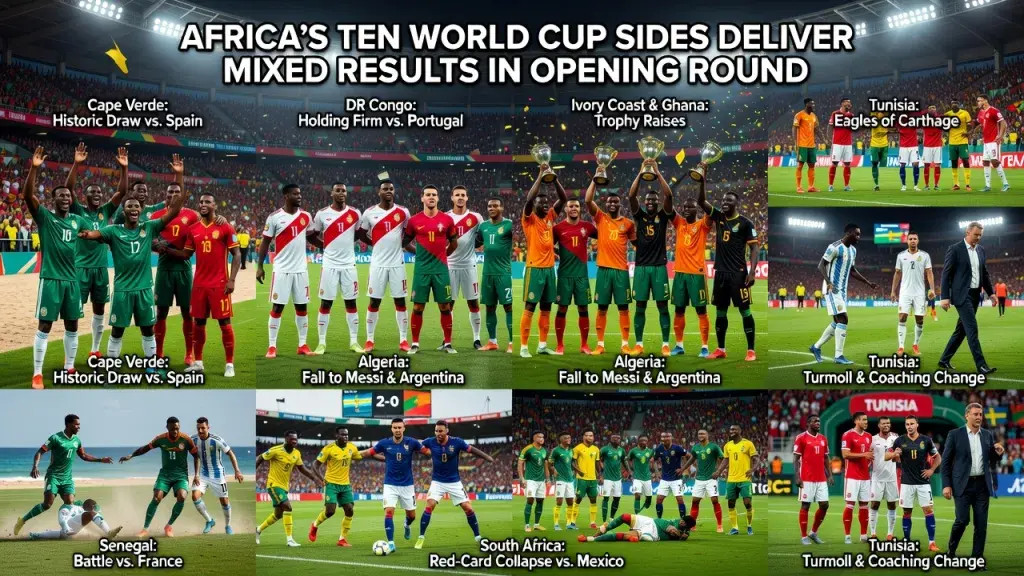
Authored by cn-ayxsports.net, 18 Jun 2026
A record 10 African nations took to the pitch in the opening round of the 2026 FIFA World Cup, and the continent delivered a snapshot of its full range - from historic draws against European royalty to heavy defeats and a managerial sacking before the group stage is even halfway done. The expansion of the tournament to 48 teams gave Africa its largest-ever allocation of places, and the first round of fixtures has already confirmed that the continent's representation spans genuine contenders, plucky debutants, and sides still finding their footing on the biggest stage in football.
The 10 games produced two African wins, four draws, and four defeats - a summary that tells part of the story but not all of it. Context matters enormously at a World Cup, and the identity of the opponents faced in matchday one goes a long way toward explaining the variance in results. For fans tracking the tournament across multiple sports this summer, it is worth noting that even adjacent pursuits like bet on padel have been drawing attention in North America during the World Cup period, but nothing is commanding the continent's focus quite like these ten African nations in the group stage.
The Standout Results: Cape Verde and DRC Earn Respect
While victories for the Ivory Coast and Ghana represent the cleanest outcomes from an African perspective, the most emotionally resonant results of the opening round came from Cape Verde and the Democratic Republic of Congo. Cape Verde, playing in their first-ever World Cup fixture, held Spain to a draw - a result that will be talked about in Praia for generations. The DRC, returning to the tournament after a 52-year absence, did the same against Portugal. Neither side simply parked the bus and survived; these were statements that Africa's emerging nations belong at this level.
Morocco and Egypt also drew their respective openers, meaning half of the continent's representatives came away with at least a point. For Morocco, who reached the semi-finals of the 2022 edition in Qatar, anything less than a deep run in this tournament will feel like underachievement. Egypt's draw, while less celebrated, keeps them in contention ahead of what will be a defining second fixture.
The Difficult Draws: Algeria and Senegal Pay the Price
Algeria and Senegal were always facing an uphill task when the draw placed them against Argentina and France respectively - the last two World Cup winners. Losing those games does not carry the same stigma as losing to a comparable opponent, but both sides will need to respond quickly. Senegal, in particular, carry expectations as AFCON champions and one of the continent's most complete squads. A defeat to France in game one is survivable; a second loss would almost certainly end their campaign before it has started.
South Africa's situation is more complicated. Bafana Bafana, the tournament's co-hosts alongside the United States and Canada, lost 2-0 to Mexico in what was the opening game of the entire competition - and they did so with nine men. A red-card collapse at such a moment, on home soil and in front of a global audience, is the kind of start that haunts a squad's mentality for the rest of a group stage. The manner of the defeat will sting far longer than the scoreline itself.
Tunisia Sack Lamouchi After Five-Goal Hammering by Sweden
The most dramatic off-field consequence of matchday one has come from Tunisia, who were beaten 5-1 by Sweden - a result that prompted the Eagles of Carthage to immediately dismiss head coach Sabri Lamouchi. The scale of the defeat made the decision swift and arguably inevitable. What makes the result even harder to process for Tunisian supporters is the identity of the opposition: Sweden qualified for the tournament not through the conventional UEFA qualifying route but via a Nations League playoff spot, having failed to win a single game during the primary campaign. To be dismantled by that version of Sweden represents a significant low point.
Their replacement appointment carries genuine intrigue. Herve Renard, the Frenchman who has won the Africa Cup of Nations twice with different nations - Zambia in 2012 and Ivory Coast in 2015 - takes charge of a side that needs a complete reset within days. Renard's record in African football is almost unmatched at tournament level, and his ability to galvanise a dressing room quickly is well-documented. Whether he can salvage Tunisia's World Cup from what looks like an almost impossible position remains to be seen, but if anyone has the credentials to try, it is him.
What the Opening Round Tells Us About Africa's World Cup
Ten games in, Africa's representation at the 2026 World Cup looks like a competition within a competition. At the top end, Morocco and a rejuvenated Ivory Coast side have the pedigree to advance deep into the knockout rounds. Ghana and Senegal have the squads to follow if results go their way. Cape Verde and the DRC have already exceeded expectations and bought themselves genuine belief heading into matchday two.
At the other end of the spectrum, South Africa, Tunisia, Algeria and Senegal face the very real prospect of elimination before the group stage concludes. The expanded format, which introduces a third-place qualification route through each group, gives all four sides a mathematical lifeline - but lifelines require someone to throw them. The second round of fixtures will be far more telling about which African sides are truly equipped for the tournament's latter stages, and which are playing out the remainder of a brief stay in North America.